

Vardis – interview met Steve Zodiac, Joe Clancy en Roly Bailey
Steve: “You’re kind of an addict, and playing live in front of an audience is the best drug”
De ‘100 M.P.H.’ elpee van Vardis uit 1980 is één van die helemaal grijs gedraaide platen uit mijn jeugd. Dit blijkt ook zo te zijn voor Nick Helmond, de organisator van Zeeltje Rock, tijdens een interview eerder dit jaar. Omdat Vardis dit jaar op Zeeltje Rock speelt, is navraag naar de mogelijkheden voor een interview natuurlijk een logische vervolgstap. Dit wil Nick best voor mij proberen te regelen.
Cor Schilstra Ι 17 september 2026
Een paar dagen van tevoren kom ik erachter dat ik pas kort voor aanvang van de Vardis show aanwezig kan zijn; hopelijk wil de band ook naderhand nog een praatje maken. Vroeg in de middag van de dag zelf komt er telefoon; of ik al op het terrein ben, want de band geeft de voorkeur aan een interview voor de show. Dit gaat dus niet lukken. Tijdens het optreden, waarvan ik uitermate genoten heb, moet ik een paar keer denken; “het zou toch geweldig zijn deze mannen even persoonlijk te spreken”. Terwijl de volgende band Hard Buds staat te spelen, krijg ik een appje; Interview NU. Yess!
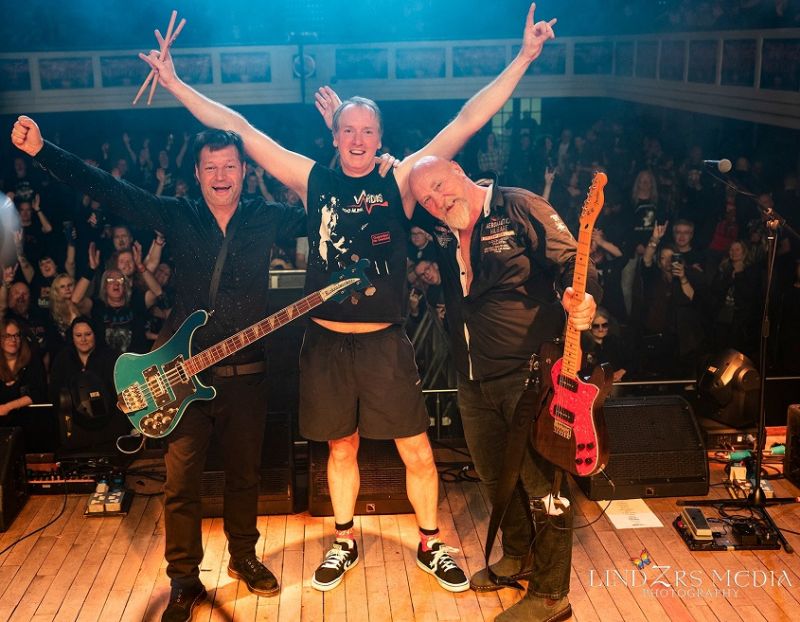
In gezelschap van Nick en de band manager (blijkt later de zoon van Steve Zodiac te zijn) lopen we Backstage naar de kleedkamer-containers. Voor één van die containers zitten de mannen van Vardis na te genieten op hun tuinstoeltjes, alwaar Nick een omhelzing van Steve krijgt en een paar veren in zijn achterste (“Fantastic man! This is the best organised festival we’ve ever been; it’s great here!”) Omgekleed, maar nog steeds na-zwetend in de weer met handdoeken, vol adrenaline en in opperbest humeur, wordt ook ik zeer vriendelijk onthaald, en er wordt een stoel voor mij bijgeschoven. Mijn deel aan complimentjes zal ook snel volgen.
Interview:
Thanks for making time for me after the show; truly great! This was your first show again in quite some time. How was it to play live again?
Steve: Great! Go, go, go! Everything is very well organised here, and it all went great! I felt like eighteen again! I imagined my long blond hair being back, waving through the air you know.
Joe: It doesn’t matter how much you rehearse, you can play and play, but when you go on stage it’s very different animal. When you’re up on stage it’s always different, things happen, things can go wrong, it’s never the same as when you rehearse. And that’s what’s great about playing live.
I actually had a remark about that planned later in the interview, but being at this point; there are a lot of bands who play their songs exactly the same live compared to the album, night after night.
Steve: Yeah, bullsh#t man, don’t get me going!
Joe: No, don’t get him going! He can go on for hours!
It’s kind of a trademark for you guys to play your stuff differently every time. You like to play your music in the heat of the moment, small “mistakes” can add value, and you cherish the jam-like moments of improvisation or adapting to the situation. Something I personally can appreciate very much also.
Steve: (a compliment will be returned) You got it man! Ha, ha! That’s why you are also part of this! (to Joe and Roly) I told you, I f#*king told you!
There seems to be some kind of chemistry between you guys that allows that free-wheeling to make it fit for that moment.
Steve: (to Joe and Roly) See? Hey, hey, he understands it! Me and him are best mates!
Joe: Well you got the very well known bands like Metallica (Steve: Oh no!) No, no, there’s some good stuff like Rush and so, who are pretty versatile, but also very well organised, but sometimes …
Steve: Hey, we’ve got triggerpoints!! We call that triggerpoints, so we all know where to go at a certain point. I missed that triggerpoint at ‘Jolly Roger’ today! I thought what’s he doing?
Joe: It has to do with the whole production nowadays.
Steve: For some it’s a theatre of some kind; loads of bands have everything pinpointed to the second. The whole lightshow and so on, ….
(at that moment a beard an a funny hat -nice shirt by the way- has to interrupt my conversation to make a promo video of his podcast Metal Matties. (It’s even a colleague who doesn’t recognise me)
Joe: … but with us it it’s more about fluidity …
Steve: … and expression, and what the crowd wants of course! Their response is very important. They give you the energy to move on. You don’t follow some kind of script, you know. You react on what’s going on, and that’s where you get the energy from.
You guys don’t interact with the audience with rehearsed speeches, but there certainly is a connection, a line between you on stage and your audience ..
Steve: I have to tell you something; rock ‘n’ roll isn’t in language, rock ‘n’ roll is here (pointing at his heart)! And going to the audience, because we are, the chemistry, you said the word chemistry, and that’s music to my ears, we experience that chemistry between us and the audience. We as a band have that connection, and on stage we often feel we can share that with a large part of the audience.
I’m an old c#*t you know (Joe: mind your language!) No, but I am, I am old school, I saw Little Richard, Chuck Berry and also a band like Black Sabbath in 1971 in Sheffield, Rory Gallagher, T Rex, Slade and Status Quo in their good years. Rock ‘n’ Roll is about feeling. I believe that Rock ‘n’ Roll didn’t exist before World War II. When World War II happened and the whole world … (Joe tries to interrupt) Sss, you, after World War II, young people thought “F#*k You”! And if you think I’m wrong, think again! Before you had Bing Crosby, a great musician, but not Rock ‘n’ Roll. Afterwards you had the new young generation with Elvis, Chuck berry and Little Richard, and later on Pink Floyd, Led Zeppelin, and so on.
Back to your music; your debut album ‘100 M.P.H.’ is one of my most played albums in the early eighties. This live album with the “Guaranteed no overdubs” in writing and in music, worked out pretty good. The direct and honest material was appreciated by a growing audience. Was this a plan or a lucky shot?
Steve: Do you want the honest answer? ….. It was a lucky shot! We didn’t have a f#*kin’ clue. We were not aware of what we were doing. I think it was a risk, but you know, we were playing that songs like ‘Move Along’ and ‘Let’s Go’ and so for a couple of years, in the clubs and we thought, let’s just record a live album and get it done. We just wanted to have our record. When we got our record deal, we just wanted to have our record as fast as possible, and the fastest way was a live album. I got to say, we were lucky also, but you have to have a bit of luck, don’t you think so? You have to have that lucky break. That goes for all musicians, even for football superstars like Messi or Maradona. On the other hand, you also have to be persistent in getting that lucky break. A lot of people think, oh, success is around the corner, but if you don’t keep pushing, you won’t get to that corner. Does that make sense?
Joe: Looking at the music, when you go back to the live albums of the seventies and eighties, for example take ‘Live And Dangerous’, an amazing album, but we know it’s an album with very much parts being done or redone in the studio. That’s okay, because they created an atmosphere for the audience and the album and the music is great. We all wanted the album. But when we for example did the ‘100 M.P.H. @ 100 Club’ album (the anniversary album from 2021 with Joe and Roly), we rehearsed, but we didn’t play that much together, we did a couple of gigs before the 100 Club, and we knew from that moment it was going to be one take. We recorded it from start to finish, and we didn’t mess with that. And I think that was pretty unique. Also because it was just that one show, that one night. Lots of bands record five, ten or even hundred shows, they’ll choose parts, then put it together and the final result is the best parts from many different gigs and often also some bits left out or added afterwards. I tell you, I saw Metallica in Copenhagen, in 2024; brilliant gig I must say. So when I got home, I ordered the live CD, because they release about everything in live gigs nowadays. But when I heard the live recording afterwards, I remembered Kirk Hammett having some bad moments, and Lars Ullrich with some small mistakes in his rolls with ‘One’, which I couldn’t discover in these recordings. They must have tempered with that a bit.
Steve: The ‘100 M.P.H. @ 100 Club’ was just that one chance to get it right, and I think people appreciated that. Man, even the original ‘100 M.P.H.’ which also had no dubbing whatsoever, but it wasn’t a recording of one single show. I think it was recorded during three shows.
Something else about that ‘100 M.P.H.’ album: the timing was quite remarkable and must have brought some challenges also, in mixing/finetuning, and in the further process.
Joe: Yeah, I think we were the last band playing live in London, before the actual shut-down of the Corona pandemic.
Steve: It was crazy man! Yeah, I think we were the last band to play. And then afterwards, when we had the recordings, me and Joe both have a recording studio, and we used WeTransfer a lot for sending over stuff back and forth. I know guys like Brian Adams and Springsteen have done that a lot, sending stuff all over the world, and mixing and tweaking recordings and so on. But for us, it was quite a challenge, yes. In the end, we managed though. We had the basic sound files from the 100 Club, me and Joe, Joe is a hell of a sound engineer! He also got a great studio, so together we could get this great result.
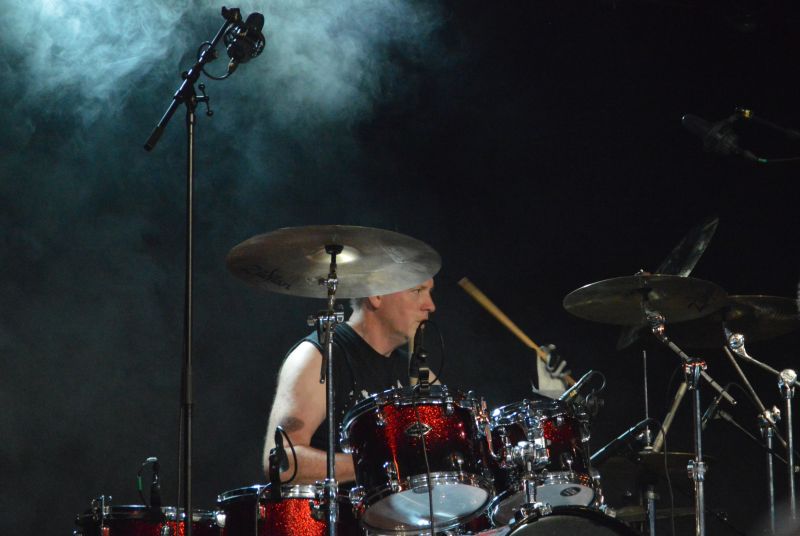
Roly: There’s another unique thing about the live recording of just one show; we as musicians can remember every single moment from that recording, when listening back. I know exactly all those details of what was happening, that’s also great.
Steve: That’s already a tough job with the three recording nights of the original, but impossible when you record a whole tour, and pick out the best moments from every show. I mean, we knew we had just one shot to get it right.
Lucky shot again! We’ve been into the loose, versatile approach, of playing songs live. Does this approach also exist in the songwriting process? I know Steve writes the basic structure and lyrics, but do the other guys also add things in jam-like situations in the rehearsal room?
Joe: Speaking for myself, I think fundamentally Steve writes the songs. He’ll come to us, we will play the song several times, while we add our own different ideas in mainly rhythm elements, and then we choose which one is most suitable.
Roly: When Steve comes up with a basic idea, I try out different things, the freedom for me is to take the song and express myself. I don’t think you have that freedom in many bands. In many bands it’s like: “I want the bass to sound like this”, you just have to do that.
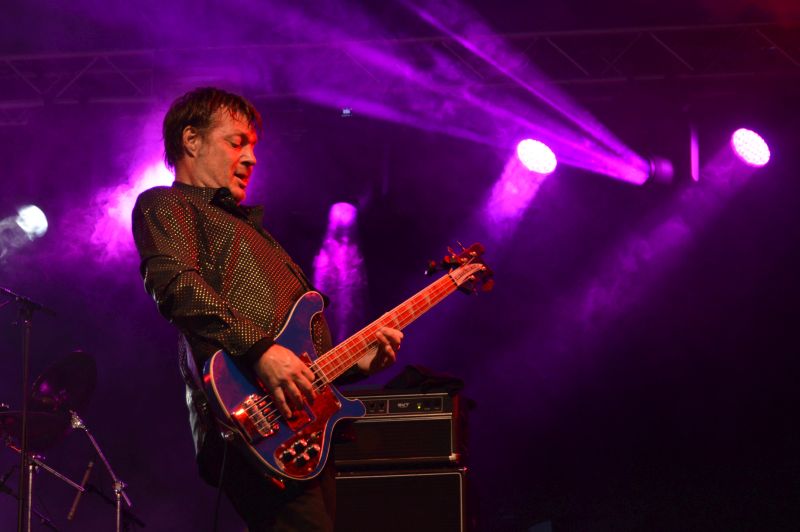
Your bass playing is also pretty flexible; you’re “walking” licks and scales just as easy along the whole length of your bass, using your fingers, as hitting it the strings hard with the plectrum, to get the more punching drive.
Joe: When you came, you said, I can play with my fingers, I can play with a pick. That flexibility was very much appreciated. I mean the early Vardis stuff was mainly with a punch, with a pick.
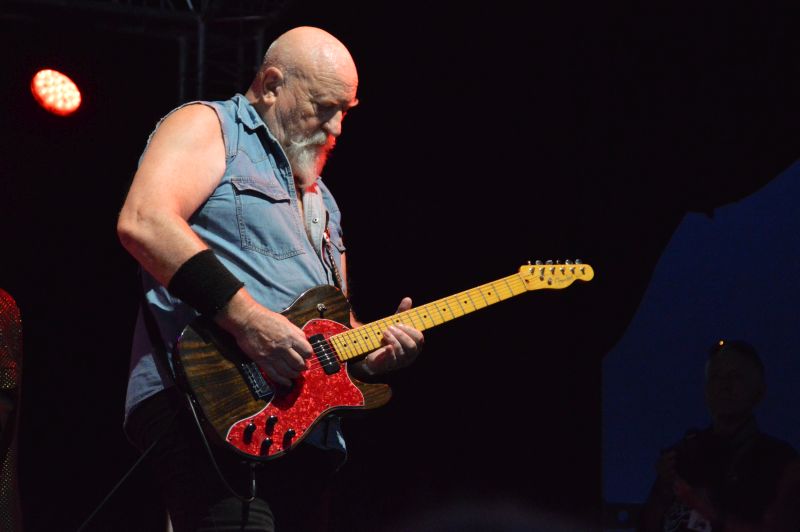
Steve: He’s versatile! He’s got that punch! But to be honest, the evolution of a Vardis song actually starts of with a little melody in my head, and a few words that feel passionate to me. And from that point, I get an acoustic guitar, I sit and I just strum. The melody comes from those words, I don’t know why, but it does. And from that I create a sequence of verse and chorus, and so on. All on acoustic guitar. And in the next step I take it from the acoustic to the Telecaster.
Why that passion for the Telecaster? This type of guitar isn’t very common in your kind of music.
Steve: Because the Telecaster is wild! It’s crazy, there’s no control. I mean, I have a Les Paul, an SG, but it doesn’t have that, uhm, it’s like a knife! It’s sharp and wild! I like that!
You also have that great load of pinch-harmonics as kind of a trade-mark
(Joe laughs) Steve: Some time ago, at a gig, I had hit the strings so hard, my nail was halfway gone (Steve points out on his finger). There was blood all over the place. Even my t-shirt was covered in blood. It was bad you know, it was two hours, and this was ripped up completely.
But back to the question about the guitar; I like country, I like Hank Williams. I don’t write songs as metal, I write them as country/blues. I love Johnny Cash, I love Elvis, Chuck Berry, Little Richard, so I write songs like this, and then I go to these guys, I grab my Telecaster, and turn on the amp, and Vardis comes out.
What kind of amps do you prefer?
Steve: I used to have a Selmer in the beginning, and when we got more known, we got a deal with Marshall. It was actually Jim Marshall who took us around the factory and he said “what do you want?”. I said; “one of them and one of them”. (Joe: The candystore) So I walked out with two Marshall stacks. ….. And after that I didn’t play for some years, I retired from the industry.
Yes, there has been quite a radio silence for some years indeed. Vardis as a band did not exist anymore….
Steve: I had my personal reasons. Well, I actually had some big problems with my management. I don’t know why I’m sounding like I am moaning about this, but you know, it’s the same old story about people trying to f#*k you up! I don’t mind getting ripped off, but I need to know that I get ripped off. And at least admit it when you’re confronted with it.
What did you do in the meantime? Did you also find another job?
I always had a fascination for science. When I left school I was an engineer. Because I was into the audio stuff, I wanted to know how a recording studio worked and went into sound engineering. I got a job as a sound engineer at a theatre in Sloane Square in London. I believe that when I went into sound engineering, I was part of creating, and this led me into education. To get students to learn about music and how to make a living of it, being part of that creative process was very satisfying. At the same time my wife was pregnant, so for the situation, this was all very convenient and stable. In a way it was difficult to leave the stage behind, but I couldn’t go back to those b@$tards! It’s not about the money, I don’t care, but it’s the backstabbing situations that I can’t stand.
Still, you found your way back to the spotlights.
Steve: When you’re a performer, you know the adrenaline and the kick of the stage. There is always an urge to go back. You’re kind of an addict, and playing live in front of an audience is the best drug; there’s nothing that compares with that feeling!
Thanks for taking the time for this guys! As final question: are there plans for new studio material, is there going to be new studio Vardis album?
Joe: Yes, we’re working on it. And the release will not be too far in the distant future. The songs are written, and I think it will be true Vardis material, as many expect from us, but there will also be some surprises.
Steve: It’s always rock ‘n’ roll!