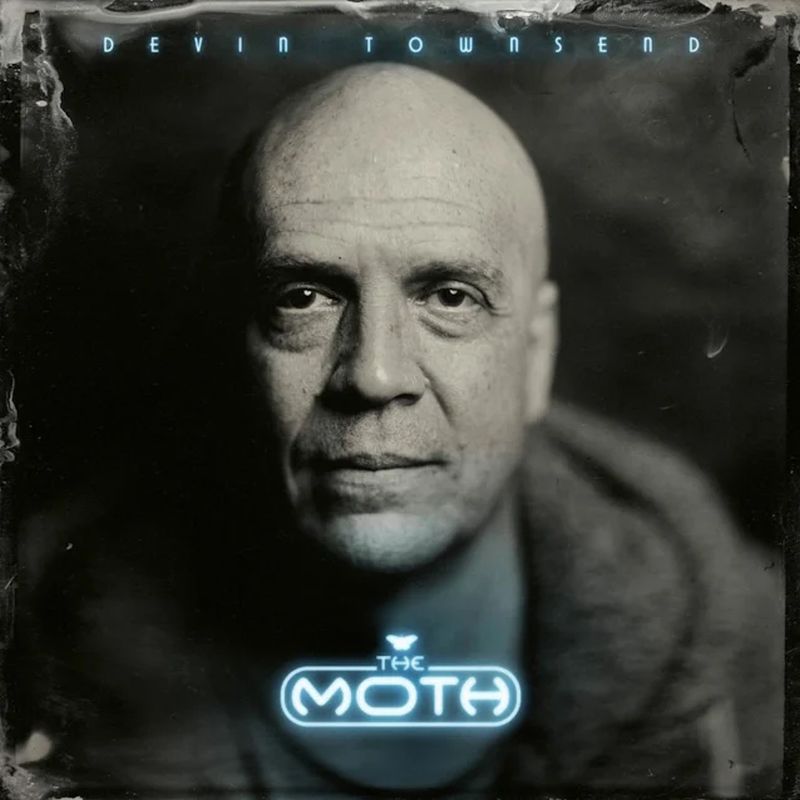




Interview met Devin Townsend
Devin Townsend: “Every scenario offers you only two options: either ‘fuck it’ or ‘deal with it’. So that became our credo.”
We wilden toch nog eens een interview met muzikale kameleon Devin Townsend nu hij spreekt van een levensdroom die in vervulling gaat. In dit geval is het de musical ‘The Moth’, zwaar georkestreerd en met voluptueuze koorzang. We waren getuige hoe de mot zich ontpopt heeft tot vlinder en krijgen het verhaal van de realisatie in geuren en kleuren van ceremoniemeester Devin Towsnend zelve…
Vera Matthijssens Ι 13 juni 2026
First I have a question about the past. The fact that you make such diverse albums and music, maybe can be found in your youth. How did you ever get in contact with music when you were young?
It was all my parents I think. I was born in 1972 so I was young throughout the seventies and the eighties and much of the popular entertainment at that time, included sci-fi movies and things like big epic soundtracks that were very impact-full. I think even more than the sci-fi movies, it were the musicals. It was the Hollywood renditions of ‘Fiddler on the Roof’ and ‘Phantom Of The Opera’, ‘Jesus Christ Superstar’, ‘Cabaret’… all that and I think because my family was so musical and because of those movies, I think that is where I learned the foundation for what I do.
Indeed. If there is any description, it is really various, all markets…
It is funny, when people are talking about variation within the music for many years, people were confused by the fact that there is so much variation and I was confused by their confusion, because I feel to myself that life is dynamic. There is no consistency emotionally, even throughout one day. So when I meet musicians that do one style, what is their life like? (laughs) Some moments I feel aggressive, some are quiet, sometimes I just don’t feel anything… as a musician I just want to express all those things. So the variation that comes through my music I think is a very human one, rather than an indicator of imbalance. It is a good outlet if you have the opportunity to do that I believe.
This time you really go for an orchestra, choirs and big arrangements. I guess this was a dream of you for a long time, where did that come from?
I remember I was eight years old and I was thinking: ‘oh one day I would like to make something that is within this kind of format’. I think the goals that I have as a musician are very intangible. I don’t have a check list of things that I am trying to accomplish. I just wake up and write. I think more than anything else, because my creative process is rooted in ‘whatever comes in, is what is going to go out’. And the last few years have been, by any measure, fantastically strange and so I think that…. well, I did an interview the other day and the interviewer asked me: ‘why is the record so chaotic?’ and again I said to them: ‘I don’t know what your last few years have been like.’ (laughs) but this is just a direct reflection of the input as an artist, right?
At a certain moment you let things go about that huge dream and later it was in the Netherlands happened something that makes your dream come true, isn’t it?
Yes. The Netherlands have always been a place that I have related to. The language and the personality make sense to me. So it has always been… there have been a lot of friends from the Netherlands throughout my life and I appreciate the honesty, I appreciate that I know where I stand with people and I think that, for the sake of my own creative process, efficiency is very important, so the less time we have to spend with bullshit, the better. I think that the Netherlands have always been synonymous for that, on some level for me. So I think it is just about finding a connection somewhere. About seven years ago, I was playing an acoustic show in Amsterdam and Markus and Claudia, who were the heads of the North Netherlands National Orchestra and Choir, came to the show and offered the opportunity to interpret some of the old music with this amazing orchestra, but I saw it as an opportunity and just asked them a favour and asked them if they were willing to do something new. After a couple of days of thinking about it, they came back and said ‘yes, we are willing to do that’ You have to deliver this material by this date, we have to have that by this date’ and then from that point, it was almost the impulse to begin. It all blossomed from that.
It must have been a huge work…
Yeah… I must say the logistical challenges for every record can be difficult, but this one in particular was huge. There is no way that I could have done it on my own, so the first course of business for me was select a group of people I could delegate tasks to. So that I could say: you can run the choral part, you can run the orchestral part; you run the band part… and then I just deliver the parts to each person that was the head of that team and then they would be able to articulate with the choir, the orchestra or the band. I realized that logistically it was a monster. Things that became the most important very quickly, was the speed. For example, we had the opportunity to work in Groningen and there was a certain amount of government funding that went into the orchestra, the choir and all these kind of things. I realized at that point, unless we utilized that particular date, the opportunity would fall away. The orchestra was booked, we had to take advantage of it and the downside of that is that the record, I had not finished writing the record yet. So I had to make some concessions where I focused on completing the orchestra and the choir and then I guess like a ‘cliff note’ is the term, a provisory version of the band and vocals and lyrics and everything. And then by casting the orchestra and the choir, I was then able to go down the road a little bit more intentional about the other parts. But every step on the way, by this particular project, was the thought that it was going to fail. (laughs) Every step.
This is stressful!
Yeah I think the benefit of having it as a constant throughout the process, is after the first experiences of thinking that it was going to fail, you just get used to that feeling. Something like, if your broken arm is getting better, it is like getting used to it. I think you just increase your tolerance for that type of trauma and then just precede. But again, with a team of people at least I had solidarity, at least there were people that worked in that trench with me, we all thought it was going to fail, so I didn’t mind.
Congratulations that you finished this huge work in a good way…
Well, I think that the options are to… I remember hearing someone just recently when we were going though a moment of stress with work and relationships and things that we all go through… and a friend of mine said to me the other day as well: every scenario offers you only two options: either ‘fuck it’ or ‘deal with it’. So that became our credo. We just kept going and deal with it. It makes things easier! Surely when it comes to the artistic temperament, it is so easy I think to allow the passion of creating music to control your reactions to these scenarios and it is important to split your mind I think, in a way, when you are doing these things, to be able to say ‘okay now I am passionate’ and ‘now I have to be practical’ and it is easier said than done, to be fair, but it is possible.
These are two very different emotions…
Again, this is the benefit and the strength to have a team; because I know that for example checking the emails or helping family members and things like this, these things are taking a lot of time and I hadn’t recognized at that point how much of my day was spent by doing other tasks, for example laundry… all these sort of things. So I thought that my life has been busy. I have a good skill for logic, but the problem with that is unless you make time for the artist, the music is just logic and it is an emotional art form. You try to connect with people, you try to connect with yourself and go deeply within yourself and go deeply into your process and if you are coming to that from a logical kind of view, it’s never going to work. It was delegating this time, that became the main challenge.
Why did you call it ‘The Moth’ and what about the concept?
I tempt to name projects based on intuition. I think because the initial concept of the moth began more than ten years ago, the original moment when the name came up was very unremarkable. It was just ‘oh, the project will be called the moth, it’ll be about transformation, it’ll be dark, it’ll have a big scale, the themes will be rooted on trauma, it will be about freedom, it won’t be easy’. But I made those notes more than a decade ago, so I just kind of put it aside and then when the people presented the opportunity to work with the orchestra, at that point, I started to say ‘okay, so what was that idea about?’, ‘why had we thought about the moth as being as a useful metaphor for this’, but I would say more than anything else in my creative process, is that I rely on intuition. More than planning and so my intuition and my sub conscience is often years ahead of my conscious mind and my fear and my hang-ups. So I tend to follow that intuition in the directions that I feel most in private. What is the most interesting thing for me? What was surprising, is when I finally started working on ‘The Moth’, my life just followed that. The transformation that occurred, children moving out of home, ends of long term relationships, all these time coincided with the process and when I started recognizing it: the idea of the moth being so attracted to the light that it destroys itself. At first I have seen that as a negative connotation, because it is almost like saying ‘okay, you are going to destroying yourself’, but by the end of the project, I recognized that was meant to be destroyed were things that weren’t necessary at all. So to integrate your darkness, to integrate your shadows, to sit with your pain, to sit with your trauma, to work through that so you can feel to a certain degree, compassion with yourself, some degree of self-love I think requires the destruction of all these identities that you had created for yourself. They are not true, they are a product of trauma, they are a product of circumstances. By the end of the project, the name, it is like my conscious mind caught up to my sub conscious mind and started to extend.a
Can we say in a way that you have learnt something about yourself doing this?
100%. I have learnt many things and I guess at this point of the process, on the other side of delivering ‘The Moth’, the scenario I am in right now is twofold. One is integration, because of the things that you have learnt. You have to allow those things, it takes time. I am also coming out of a period in my life that has been very difficult, but on the other hand I feel what I have learned about myself, is that by addressing the parts of my personality, one time I had fear and then making peace with that, I recognized I was like a wounded child that was looking for something to protect me in some way. By finding that degree of compassion for myself, I also recognized how much of my self-worth in the past was connected to the job. Maybe I was so insecure that, in absence of being a musician, I felt like I had no worth and I think that that process of self-expects erased that. Which is fantastic on the surface, but in a practical way all of a sudden my work ethic has changed. My work ethic has gone, from wake up in the morning and start writing, to ‘hm I am just going to go to the beach’ (laughs). There is a benefit to, but it is also a liability as well, because I have a lot of dependence in my life, I have a lot of people that rely on me and so, that cannot just stop! But in the process about learning about myself and learning about the process of being human even, is more important than any of the work. It is the foundation of why artistry is so compelling to me, it is a progression and the intent of that progression is to become a better version of yourself and so it is a work in progress: two steps forward and one step back, right? Just like two steps forward and two steps back.
Just like the procession of Echternach, it is a kind of self-punishment…
Yeah I have been known to punish myself, but I think that the best move forward for someone who had that tendency in the past, is to recognize it and then try to make progress. I think one downfall can be so critical for yourself for making mistakes. We don’t have that compassion, it is like ‘yes, I am guilty, I beat myself up for many years’, but when I recognized that, I had the choice of being continuing of beating myself up by saying ‘I cannot believe I beat myself up’. Or ‘now I recognize that I have been doing that and I hope that I can work towards enough presence that what I am doing it’. In the moment I am able to recognize that, right? All these things are a process and I am grateful to have circumstances in my life that had forced me to confront them.
In this respect I think about a very nice quote I have read: ‘courage is not the absence of fear, but being truly afraid, but facing it anyway’… That comes down on what you just told me I think…
Truly. I think there is a misconception that in order to be brave about things, you need to be the stereotypical definition of what bravery looks like. I think for some people, specifically people who are another version, sometimes just get out of bed in the morning is an act of bravery. To be able to have enough… again… compassion for yourself, so that you recognize the reasons why you are strong, a sort of comparing yourself with things that have nothing to do with your nature.
Another thing that needs some explanation. It is said that ‘The Moth’ would be a part of four albums and the cycle started with ‘Powernerd’ (2024). How can we see that?
I think because – as I said a moment ago – I don’t feel the success or the satisfaction that I feel for every project, on the music itself, but more by learning during the process. What typically happens to me, is moments of significant emotions happening in one to two year parcels. When kids move out of home, it is like a two year process, same goes when you break up with someone. These things are an ongoing thing, it takes a while to revolve and so if you look to a two year piece of time, that has been a part of my life. Because I write so much – every day I write, I just write constantly – I don’t think about what I write, I don’t analyze what I write, some days I write prog, some days I write metal, some days I write orchestra, I don’t think about it. So when that period of life starts to feel like a shit thing towards the next phase, at that point I start reading what has been written and sometimes I have written nothing. Other times I have written enough to fill four or five records and so basically I utilize a period of emotional development as a parcel in music as well. ‘Powernerd’ was a parcel – and they don’t have to sound like anything, it is all kind of connected by the emotional thread, more than the musical ones.
Why was it so important to you that the next video you launch is ‘Home At Night’?
I just think because the next video that we are doing – it comes out in a couple of weeks – is very heavy. I like doing different things, so I want to show as much sides of me as possible. For me I am very comfortable being myself and it doesn’t bother me in the slightest that me and myself doesn’t fit in. I never fit into the scene, ever. So it is incredibly freeing. If people say ‘that is not cool’, well, then I don’t want to be part of the club that doesn’t allow that’ because that’s what I feel like doing. That is really the artistry, there is no need to be provocative, there is no desire to fit in, just this is what I feel like doing, this is part of the statement, and I am absolutely comfortable with people disliking the work that I do. It is of no significance to my progress or process.
That point of view only comes with age I guess…
Yeah, I think it comes with age, for sure, but I am also fortunate that I have been in this industry for so long that I have managed to gather a very, very supportive audience. It is not a huge audience, but it is very supportive and I think the criteria that the audience have is more based on artistry than on a particular style. That means something to me and so that is the only test I use for this work, whether or not this is of significance to me.
‘The Moth’ was twice played live in the Netherlands. What about that experience for you and can we hope for more live performances or do you only return as a solo artist at that level?
The show in Groningen was unbelievable stressful, unbelievable beautiful, unbelievable empowering because I felt supported by the audience, because I think a lot of the time the audience knew how difficult it was and how we were not finished. Are we going to do it again? My idea on that is I am aware of how complicated life is in 2026. I am aware of how demanding the music that I do can be for people. So I have no desire in trying to A. convince people to listen to my work, or B. try to force it on people. If ‘The Moth’ is something that resonates with people, then why not? At that point I got a story, I got a stage act, we got everything. If they want that, I am happy to do that, but if they don’t, I have got million other things I am happy to do. And then the final thing here are the acoustic shows. That is more of an opportunity for me to represent the dynamics of the band. Looking at what I have done through all these years and then reconnect with the audience before I come back. It has been a tumultuous two years and I just want to kind of put my toes into the water before I start swimming.