


Antrisch – interview met Maurice Wilson
Maurice Wilson: “Essentially, two recurring aspects shape and define our artistic approach: the band name Antrisch (eerie, uncanny) captures the character of the music, and the recurring subtitle ‘Expedition’ captures both the overarching concept and the subtle nature of our narrative music.“
In het Duitse Beieren heerst altijd grote activiteit in elk subgenre van metal. Dankzij AOP Records kunnen we nu op expeditie gaan met Antrisch. Zij brachten zojuist hun derde release uit en ‘Expedition III : Renitenzpfad’ blijkt een ware ontdekkingsreis doorheen atmosferische black metal te zijn. Verhalend in aanpak, dooraderd met fragiele akoestische passages op gitaar, maar vooral verschroeiend intens wanneer de zwartgeblakerde furie het voortouw neemt. We achtten het dus nodig om Antrisch wat uitgebreider voor te stellen in onze contreien. Dat deden we aan de hand van het logboek van deze expeditie van zanger, lyricist en lay-out verantwoordelijke Maurice Wilson. Zo komen we heel wat interessante details aan de weet.
Vera Matthijssens Ι 30 maart 2026
Congratulations with the amazing new album! We want to introduce the band properly in the Netherlands and Belgium. How are you doing at the moment, satisfied with the new release?
Hallo Vera, hartelijk dank voor het compliment! Well, the actual release is still to come, but we’re certainly pleased with the feedback we’ve received so far for our two pre-released singles, as well as the press response. Given that we’ve completely thrown certain expectations (snow, ice, cold, mountains or the Arctic) out of the window – and naturally couldn’t be sure how people would take it – the echoes we’ve heard so far have been truly fantastic and have confirmed that we made the right decision. We’re currently in a rather busy – not to say stressful – phase, as, in addition to the upcoming physical release of the album, we’ve also got the live premiere to look forward to, which naturally involves rehearsals and organisation.
Antrisch was formed in 2020 during pandemic times, but I noticed that several members have been in Kromlek (also a great band!). Can you tell how Antrisch came into being? What were the intentions for musical direction, lyrics and all things concerning a new band when you decided to start Antrisch?
You’re absolutely right; at the time it was formed, 50% of KromleK (Mr Scott, Mr. Шмидт and my humble self) made up 75% of Antrisch. MW: Mr Дятлов, the fourth member of the group, had, however, already been active before Antrisch with Mr Scott and Mr Шмидт in a band called 7th Abyss. With the arrival of Alexander Gordon Laings as live guitarist, another former KromleK member found his way back to us. And to top it all off: the two remaining KromleK members, Julian Dietz and Vitalis Eirich, have both contributed to Expedition III, which effectively reunites the ‘old gang’ for a short while, albeit under a different banner. But after that brief digression, back to the beginning: Mr Scott contacted me out of the blue sometime around 2019/2020 and asked if I’d be interested in a black metal project (something we’d wanted to do ever since we met); he said there were five songs and he needed lyrics and vocals. As chance would have it (though I don’t believe in chance), I had five lyrics tucked away in a drawer for a mountain drama concept, which were originally intended more as a collection of poems and not for use on an album. The moment the music and lyrics converged, Antrisch was born. It felt like a form of predestination, and it became clear to Mr Scott and me once again that we were probably ‘doomed’ to make music together for as long as we lived. Mr. Шмидт who had already overseen the recording of the five songs (which became Expedition I), was also very taken with the concept, and so one thing led to another and Antrisch found his bassist and producer. As for the intentions behind the Antrisch project, the lyrics of ‘Expedition I’ have basically shaped the direction of our work, as a concept centred on historical expeditions struck a chord with all members alike, and so this concept took shape more and more; and since – as already mentioned – it had always been Mr Scott’s and my wish to create a black metal project, the lyrical and musical visions fitted together perfectly.
The EP ‘Expedition – Dissonanzgrat’ (2021) was still based on a semi-fictional topic. What can you tell about it?
Sure. At the time these texts were written (around 2014), I was deeply engrossed in the works of mountaineering legend Reinhold Messner, and this left a strong, lasting impression on me. I had the idea of telling a fictional mountain drama, which nevertheless contains some references to real events and people, such as Hermann Buhl’s first ascent of Nanga Parbat, Edward Whymper’s race to the Matterhorn, and perhaps even a hint of Petrarca. The story tells of a reclusive Romantic poet who, driven partly by sentimental infatuation and partly by his aversion to other people and the drudgery of everyday life, joins a rope team of mountaineers in order to escape the mundane world and find himself on the mountain. As the expedition progresses, his infatuation escalates into delusion and the protagonist loses himself in fantasies and imagined jealousy over who will reach the summit first, which is why he breaks away from the group and sets off for the summit on his own. As the story unfolds, he is confronted more and more with the merciless forces of nature in the high mountains and, equally, with the depths of his own soul, until he ultimately meets his death, emaciated and delirious with fever.
Then the full length ‘Expedition II Die Passage’ (2023) told a complete story of something real in the Arctic area. Can you go deeper into that concept?
Well, telling the whole story would probably go beyond the scope of this interview, but I’ll try to get to the heart of it. The historical backdrop to Expedition II is the expedition led by Sir John Franklin, who set out for the Canadian Arctic in 1845 with the two ships HMS Terror and HMS Erebus to explore the as yet uncharted parts of the Northwest Passage, discover the final route through it, and open it up for the British Empire. Unfortunately, the expedition ended in disaster, as the pack ice – which usually thaws or retreats during the summer months to the extent that the passage becomes navigable – did not retreat, and the ships consequently became stuck. This situation did not change in the following summer either, so that (following the unexplained death of Sir John Franklin and several other deaths from lead poisoning) the commander of HMS Terror took the fateful decision to abandon the ships and, together with the crew, set off on foot across the pack ice towards the south, using the lifeboats as sledges, in search of the safety of the mainland. During this march, all the expedition members gradually perished, most of them – despite a few instances of cannibalism – from starvation. The story of Expedition II begins the moment it becomes clear that the ships are stuck in the pack ice. In six chapters, I recount the different phases the crew goes through, from the oppressive monotony on board the stranded vessels, through Sir John’s funeral, to the abandonment of the ships and the inner struggle and mental anguish each individual faces when confronted with the unimaginable situation of having to eat human flesh to avoid starving to death themselves. The fundamental question at the heart of ‘Die Passage’ revolves around is how the helpless and hopeless exposure to an extreme climatic situation affects the inner life of the individual; what it does to you when you find yourself on the threshold between being a rational, moral representative of a highly developed civilisation and an archaic, instinct-driven creature devoted solely to survival. That is the second layer of meaning in the title: the transition.
You call your albums ‘Expeditions’. That evokes the feeling of something unknown, going for an aim you have in mind, but hoping for new discoveries or even surprises as well. Is that the way you approach music as well?
Exactly. Every album is an expedition on multiple levels. The most obvious aspect is the concept or story itself, but for those of us involved, it’s a holistic journey – an expedition encompassing all the highs and lows of the creative process. Mr Scott embarks on his very own musical expedition to use sounds to paint the pictures that my lyrics (are meant to) conjure up on another level. It’s much the same for me: I immerse myself in the subject matter and delve into the depths of my own soul to uncover parallels, and to infuse these sometimes very sombre events with life, relateability and authenticity. You could certainly see this as an expedition into one’s innermost self. Essentially, two recurring aspects shape and define our artistic approach: the band name Antrisch (eerie, uncanny) captures the character of the music, and the recurring subtitle ‘Expedition’ captures both the overarching concept and the subtle nature of our narrative music.
Who are the main composers in the band and for lyrics?
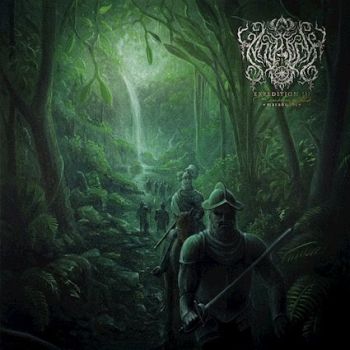
Mr Scott is the main composer, and I’m responsible for the concept, lyrics and visual design (though this mainly involves the layout, choosing historically appropriate fonts and so on; we have the artwork painted by Timon Kokott, the trusted and talented artist we rely on). Mr. Шмидт in his role as producer, naturally has a certain influence on the composition process, but essentially we have a fairly strict division of responsibilities.
The new album brings us in Latin America (from the icy arctic to heat) for a concept about quite a controversial conquistador Lope de Aguirre. What kind of man did he was? What happened to him and his men during this expedition?
Whilst the previous two expeditions explored how extreme circumstances bring out extreme traits and, consequently, extreme behaviour, in Aguirre these are already present and evident even before the actual story begins. What appealed to me – apart from the Amazon setting in general – were the complex dynamics that such an extreme character as Lope de Aguirre would bring to an already surreal and bizarre situation like the search for El Dorado and an Amazon expedition of Spanish adventurers armed to the teeth. Lope de Aguirre was a hidalgo from the Basque Country (northern Spain) who, like many of his peers, set off for the New World as a soldier of fortune in search of fame and prosperity. Historians describe him as mad, and his behaviour is characterised by paranoia, uncontrolled outbursts of violence and delusional tendencies. Upon his arrival in Lima, he became involved in the local civil war, though this was not a conflict between ‘citizens’ in the strict sense, but rather a power struggle amongst the resident Spanish colonists. He was also happy to switch sides as circumstances dictated. Once peace was restored, the viceroy decided to rid himself of the rebellious and restless elements by sending them, under the leadership of the veteran Pedro de Ursúa, on an expedition to discover and conquer the legendary land of gold, El Dorado. This expedition, which took place in 1560, forms the backdrop to the narrative. Aguirre emerges as a discontented troublemaker and schemer who, in the course of the expedition, instigates a rebellion against Ursúa and installs the young nobleman Guzmán as the new leader of the expedition. In this fateful turn of events, the expedition – orchestrated by Aguirre – resolves to abandon the search for El Dorado and instead march on Lima, overthrow the viceroy and renounce allegiance to the Spanish Crown. The ensuing odyssey (during which Aguirre kills Guzmán and proclaims himself leader) takes the expedition northwards to Venezuela. An island off the Venezuelan coast called Isla Margarita serves as a refuge for the rebels, where they take the governor and the Spanish upper class hostage and establish a forty-day reign of terror. Under pressure from the royal troops, Aguirre flees with his motley crew back to the mainland, where the final showdown takes place in the town of Barquisimeto. Shortly before this, Aguirre kills his own daughter so that she does not become ‘the mattress of the handsome ones’. This is also where the Basque Wolf meets his end. He is shot by one of his own men, then beheaded and quartered.
Why is it called ‘Renitenzpfad’? What does that mean?
‘Renitent’ can be translated as ‘rebellious’, ‘defiant’ or ‘disobedient’. Pfad means ‘path’, which is intended to give the whole work a certain eschatological character. Taken together, these two elements therefore not only describe the protagonist’s nature, but also offer, so to speak, a glimpse of the consequences of this personality trait. In Expedition III, I tell a story of intrigue, betrayal, rebellion, assassination and madness; all of this is encapsulated in the title ‘Renitenzpfad’.
When comparing to older songs, how would you describe the musical evolution of Antrisch? Are there specific new elements on the new album?
The unique aspect – and at the same time the greatest difficulty – in composing ‘Expedition III’ lay primarily in replacing the biting cold with oppressive heat, without straying too far from the character of a ‘typical Antrisch’ song. Furthermore, Mr Scott faced the difficult challenge of integrating Spanish elements into the songs without letting them become too dominant or cheesy. I think he succeeded brilliantly, even though – or perhaps precisely because – the path was a very rocky one. A notable new feature is the spoken section at the end of Song V, ‘Abkehr’: it is an excerpt from a surviving original letter written by Lope de Aguirre to King Philip II of Spain. We asked a colleague who is a native Spanish speaker to record this part for us, and I feel it lends the story a whole new level of authenticity.
Since 2024 you have two new members, one on drums and one guitarist. Can you tell why and how this switch happened?
Well, 2024 was the year we decided to turn the studio project Antrisch into a live band, and for that we naturally needed another guitarist. And what could be more natural than bringing a long-standing colleague from the KromleK days on board? Mr Laing is also an exceptional stroke of luck, because his passion is technology and we have now ventured into completely different and new realms when it comes to DMX-controlled stage shows. Mr Дятлов’s departure was at his own request, as he probably felt most comfortable with Antrisch as a purely studio-based project. The sheer number of people involved and the pressure that had gradually increased (and which he had, not least, brought upon himself through his own high standards) led him, at a certain point, to pull the plug. He decided for himself that playing live was not his thing, or rather that it caused him more grief than joy. His successor, Noel Ewart Odell, is a real asset to us, and with his arrival the band has taken a huge step forward in terms of quality.
This third release is finally supported by a label, congratulations! What is the story behind the connection with AOP Records?
Bedankt! To cut a long story short: it was very brief and uneventful. Up until then, we’d actually been quite happy to handle everything ourselves, but it had already become clear from the Bandcamp orders for Expedition II that the release of Expedition III would probably be impossible to manage without professional help. Sven from AOP got in touch with us and suggested we meet up at a gig to get to know each other. In short: the day after that meeting, we became part of AOP. And we’re very happy about it, because the professionalism, enthusiasm and conviction with which our work is met here really does us good after four years of hard work and a few crises, and we’re experiencing the appreciation our work deserves – at least in my humble opinion.
What can you tell about the live activities of the band? I guess the first years it did not happen due to the pandemic, but where did you play live or toured when things were safe again? Do you prefer touring or selected gigs?
As a band, we weren’t affected by the pandemic-related restrictions in the sense that we were purely a studio project at the time – and if we hadn’t been invited by Noise to the Noisebringer Fest in 2024, we might well have remained a studio project to this day. That was the spark that set things alight. Our journey since then has been so fast-paced and surreal that I still find it hard to take it all in. Our second concert ever then took place right in Vienna, followed by a four-date tour supporting Grima and Non Est Deus. Although we were the support act, the venues were packed to the rafters every time, and from the very first concert we had people in the front row singing along to every line of the lyrics by heart. That’s really incredible and by no means something to be taken for granted. We experience this kind of commitment on a regular basis, and it moves me to see what our music and our stories seem to give to some people. We definitely prefer the latter. Large-scale tours – that is, two weeks or more – aren’t feasible for us, as we all have work and personal commitments and can’t organise our whole lives around the band, as might have been possible when we were in our 20s.
There is even a record ‘Live at Ragnarok’ and that’s a great festival for people who like pagan/folk/black metal, just like us. What are your memories on this gig at Ragnarok?
The overriding feeling at the time was tiredness. Our set took place between 12.40 am and 1.30 am, so we were all a bit knackered. The audience, of course, were too – despite the late hour, a large number of them stuck around and watched our show. I’ve read a few comments on YouTube saying that the audience were so inactive, but on the one hand, our music isn’t really designed to get people ‘going’, and on the other, you have to bear in mind the time of day – and it’s actually quite amazing how many people honoured us with their presence. The film crew from Iridium Stream contacted us in advance and asked if we might be interested in a live recording, and we thought it could never hurt to have some visual material, not least to reflect on our own performance. At first, I thought it was a bit over the top that this turned into a ‘live album’, because we’d only been performing live for two years, and I’m used to seeing live albums from bigger bands who’ve been playing live for 30 years and released seven studio albums before finally putting out a live album. On the other hand, I liked the idea of offering the whole thing exclusively as a free download (or ‘pay what you want’) as a thank you to everyone who supports us live and plays a vital part in our live energy.
Is there something you want to tell about the visual side of the band, more precisely video clips and the artwork? The artwork fits so confronting well!
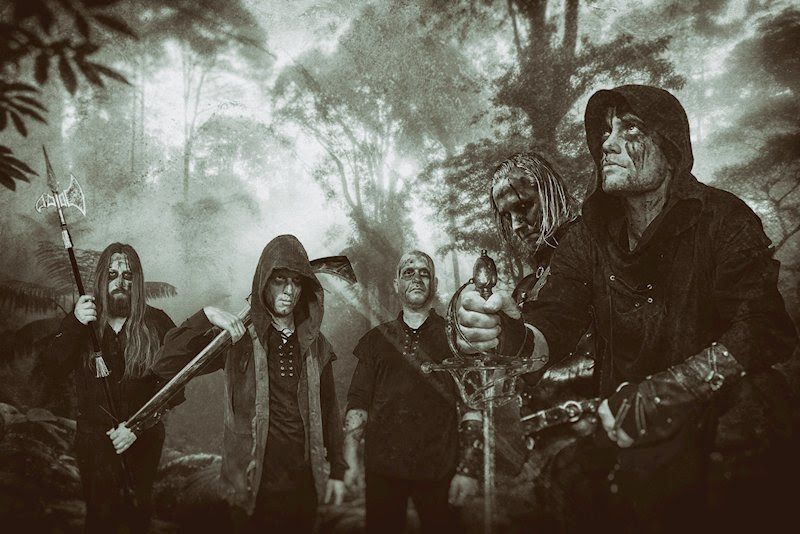
Our approach is a holistic one. Consequently, we align every aspect with the overarching concept. To me, it simply makes no sense to want to present a historical story live in as authentic and immersive a way as possible, and then take to the stage wearing a leather jacket, cargo trousers, 14-eyelet boots and a band T-shirt. That would be a disservice to all the hard work that has gone into it. In that respect, it only makes sense for us to enhance the story visually in order to create a fully immersive experience. But I digress. Back to the question at hand: we don’t actually make actual music videos (as our vision of what would constitute a satisfactory production would far exceed any budget), but rather lyric videos, which are intended to use their visual aesthetic to evoke the holistic live experience. As already mentioned, we are entrusting the artwork and all the illustrations for the booklet to the capable hands of our esteemed artist and honorary Basecamp member Timon Kokott, whom I value not only for his artistic talent, but above all for his personal qualities. I cannot imagine anyone better for such a collaboration, for the integrity and humour with which Timon approaches my rather peculiar nature are unique and always lead to fruitful results. In this context, I must of course mention the second pillar of our visual concept: Daniel Dantas of Dantas Inferno, a Portugal-based artist who is responsible for all our merchandise designs (particularly T-shirt designs) and our logo, along with its expedition-themed variations.
How did you come to the band name ‘Antrisch’?
I came across the dialect term “antrisch” in a book by Reinhold Messner, who used it to describe the lighting conditions in the ‘death zone’ of Mount Everest. The term lodged itself in my memory, and I dug it out again when I needed a collective term for the five tracks mentioned earlier. This title ended up becoming the band name because it perfectly captures the mood and atmosphere we want to convey with our soundscapes.
I noticed some gigs are planned for March and April. What are the plans for the near future?
Well, the main thing on the agenda right now is the upcoming live premiere, followed by a tour with Non Est Deus in April and May, which consists of three extended weekend gigs. After that, we’ll be playing at the Fortress Festival in the UK – my personal highlight with Antrisch – and two festivals in Germany this summer. We haven’t made any plans beyond that yet, though I’m not too bothered about it.
If there is something you’d like to add, please feel free to do it here…
I’d like to thank you very much for your time and your insightful questions. Hopefully we’ll meet up at a concert in the Netherlands or Belgium, so that my theoretical explanations can be substantiated in practice. Hartelijk dank & groeten vanuit het basiskamp!